
November 2025
Donor Spotlight: How Frank Stanford Revived a Piece of Symphony History



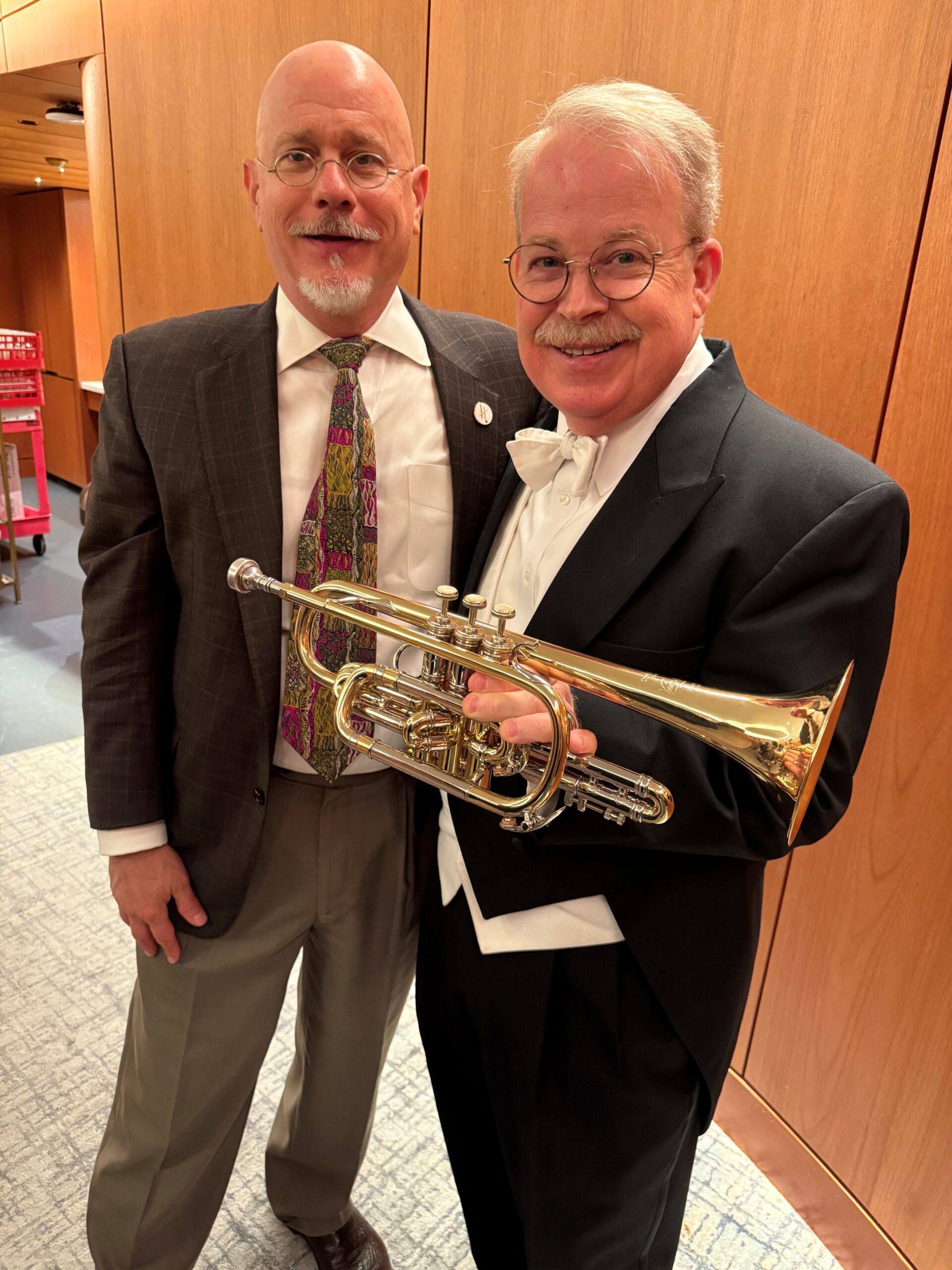
Frank Stanford and Principal Trumpet Mark Hughes with the restored cornet.
When Houston Symphony donor Frank Stanford talks about his late father, Dr. Walter O. Stanford, his love and admiration for him is immediately evident. “He was my favorite person in the world,” Frank says. “Always was.” In addition to being Frank’s beloved father and lifelong role model, Walter was a talented former musician who occasionally performed with the Houston Symphony in his youth. And now, almost a century after he first picked up a cornet as a teenager, that very instrument has found its way back to the Symphony.
Born in 1917, Walter grew up in Houston when the Symphony was in its early days as a fledgling organization. A gifted cornet player, he helped start his high school band and studied with a Symphony musician who saw his potential. By his senior year in 1935, the Symphony occasionally called him in to perform as a substitute orchestra musician.
Music was a part of some of Frank’s earliest memories of his father. “Every now and then, he’d take the cornet out and play Carnival of Venice,” Frank recalled. “I remember him playing that when I was about six years old and being mesmerized and blown away that he could make such beautiful music.” Following in his father’s footsteps, Frank learned to play the cornet as well, using that very same horn in his middle school band. When he stopped playing, the cornet was tucked away in the attic of their Corpus Christi home, where it sat for decades.
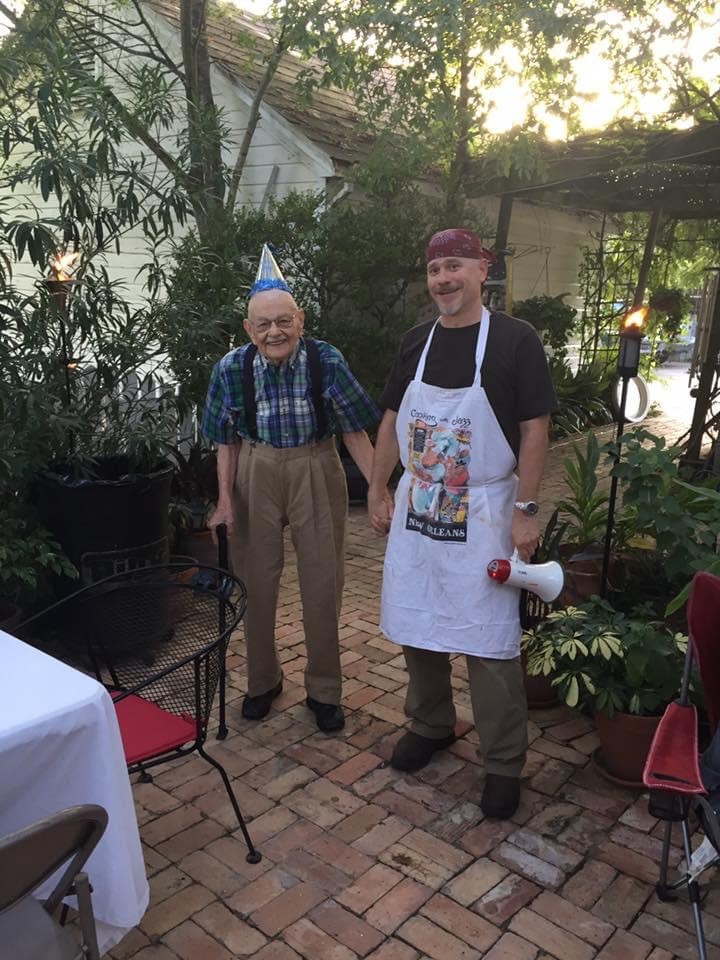
Frank Stanford (right) with his father Walter O. Stanford at his 97th birthday
After Frank’s mother passed away in 2012, Walter moved in with him in College Station at the age of 95. “He was doing great for 95, so we traveled a lot, played billiards and had a great time together,” says Frank. Their shared love of music brought them to Houston frequently to sing with the Houston Saengerbund, a German music and heritage association, and to attend Symphony concerts. Soon, enjoying Symphony concerts together became a cherished part of their routine. At concerts, ushers, Symphony staff members, and leadership often greeted Walter warmly at his seat. “They treated my dad with such kindness, even before we became donors,” Frank said. “That meant the world to me.” When Walter passed away at 99 years old, Frank knew that he wanted to honor his father’s love of music by making a legacy gift in his name. It was only after his passing that Frank thought of father’s old cornet again.
At last season’s Legacy Society Luncheon, Frank mentioned the cornet to Symphony staff member, Hadia Mawlawi, hoping that the Symphony could make use of it. “I remembered one of my old band directors telling me that the cornet was special somehow,” says Frank. “So, I said, ‘I know it’s a long shot, but this cornet’s been collecting dust, and I’d rather donate it than have it sit there.” Hadia connected him with Principal Trumpet Mark Hughes and Frank sent him photos of the horn and its serial number. Mark’s reply came back quickly. Turns out, it was a rare Vincent Bach Stradivarius cornet, manufactured in the original Bronx, New York factory in 1935. “That immediately got my attention as all of the members of the Houston Symphony trumpet section own vintage trumpets from this manufacturer, but we only had one cornet,” says Mark. “What makes these vintage horns special is their manufacturing qualities and how the brass relaxes over the years, which creates a different sound quality.” There was another reason for excitement. Mark already owned one Bach cornet from1936, and with the addition of Walter’s horn, the Symphony now owned two vintage cornets—something that’s extremely rare, even amongst most major American orchestras. The horn was in excellent condition cosmetically, but the piston valves needed to be repaired, something that could only be fixed by a skilled craftsman.

Walter O. Stanford at 18 years old
Mark recommended that Frank send it to Charlie’s Brass Works in Griffin, Georgia, who are known for their high-quality restorations. Over the next four to five months, they expertly rebuilt the horn’s worn valves, an extremely high-precision process requiring meticulous plating and honing. When the restored cornet returned to Houston, Mark invited Frank to the Green Room after a concert to see it. “Mark played a few measures of music for me, and it was amazing to hear it again,” says Frank.
Audiences will hear it too when Mark debuts the horn in Berlioz’s Symphonie fantastique, February 13-15, a piece that calls specifically for two cornets. “Our hope is that when he hears it in that concert, we can fulfill his dreams of not only bringing this horn back to life,” says Mark, “But also allow him to imagine what it would’ve been like to hear his father play with the Houston Symphony all those years ago.” Frank is looking forward to hearing it and is grateful that his father’s legacy will live on with the Symphony he loved so much. “Sometimes I get mad at myself that I didn’t think to do this while my father was alive, but now it’s like my dad is living on with the Symphony,” says Frank. “He would be tickled pink to know where his horn is now, so I’m tickled pink for him.”
–By Lauren Buchanan
Donate Today
Annual Giving Levels and Benefits
With your support, the Houston Symphony is proud to serve America’s most vibrant and diverse community with outstanding orchestral music.
View All Benefits